

Treasury Bills 💵
If you are using a savings account, you are missing out big time...

We’ve all heard about using a High Yield Savings Account (HYSA) to park our money for emergency funds, down payments, etc.
But there’s another option that many people aren’t as familiar with – Treasury Bills.
Treasury Bills (T-Bills) are short-term, low risk debt instruments issued and backed by the U.S. Treasury. They are available in terms of 4, 8, 13, 17, 26, and 52 weeks.
The big benefit of buying T-bills is mainly for the tax benefits (more on this in a bit).
T-Bills are issued at a discount to their face value and reach par value (full value) at maturity. The difference between the discounted purchase price and the par value is the interest you’ve earned.
To calculate the purchase price for a specific discount rate, use the following formula:
Price = Face value × (1 – (discount rate × time) / 360)
For example, a $10,000 4-week T-Bill sells at auction for a discount rate of 3.59%.
Price = 10,000 × (1 – (0.0359 × 28) / 360) = $9,972.08
So, the T-Bill sells for $9,972.08, giving you a discount of $27.92. After 4 weeks, when you receive $10,000, you’ve effectively earned $27.92 in “interest.”
T-Bills can be purchased from banks, brokers, and directly from the U.S. Treasury through TreasuryDirect.
One thing to note: when you buy T-bills through a broker or directly from the U.S. Department of the Treasury, you’ll often see an investment rate rather than the discount rate. The discount rate and the actual annualized yield are close but not identical because the discount rate is calculated based on the face value, while your return is earned on the amount you actually invested ($9,972.08).
T-Bill ETFs
If you don’t want to buy T-bills directly, you can purchase an ETF/fund that invests in Treasury Bills.
Of course, with convenience comes a small expense as these funds charge management fees.
Here are a few examples:
1.VBIL – Vanguard 0-3 Month Treasury Bill ETF
The expense ratio is 0.06% and the 30 day SEC yield is 3.56% (after expenses)
2. SGOV – iShares 0-3 Month Treasury Bond ETF
The expense ratio is 0.09% and the 30 day SEC yield is 3.55% (after expenses)
3. BIL – SPDR Bloomberg 1-3 Month T-Bill ETF
The expense ratio is 0.1353% and the 30 day SEC yield is 3.50% (after expenses)
When you look at the chart of one of these T-Bill ETFs, you will see something like this:
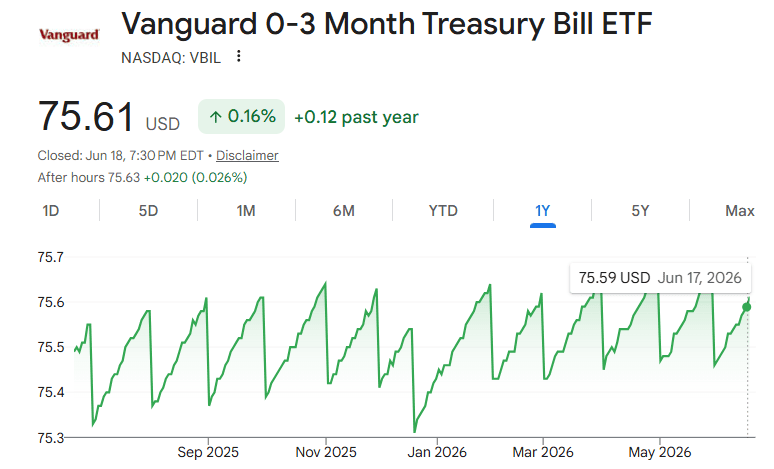
This is because these funds earn interest continuously. That accrued interest builds up in the fund’s NAV (essentially its price) over time. When the fund pays you monthly, the NAV drops by roughly the same amount.
Taxes
The interest income from a Treasury bill is exempt from state and local income tax. This is a huge advantage over HYSA, which is subject to both state and local taxes.
For example, if you have a 5% marginal tax rate and a 22% federal marginal tax rate, and your HYSA has a 3.5% yield, your after-tax yield would be 2.55%.
With a 3.5% T-bill, your after-tax yield would be 2.73%, since it’s not subject to state taxes.
So it’s not the biggest difference, but if you are saving $100,000 for a downpayment, or are a high earner in a high tax state (e.g. like 12.3% rate in California) it could make a difference. And over 30+ years of keeping your emergency funds in a HYSA vs Treasury, the difference also compounds.
T-Bill Ladder
Some people also use the “T-Bill Ladder strategy”, where they buy T-bills of varying lengths to maximize liquidity (only applies if you buy T-bills directly, not via an ETF)
Here’s an easy visualization of the concept:
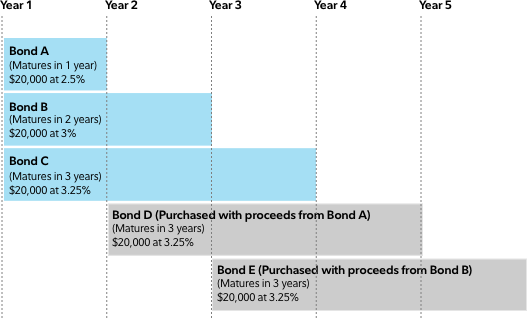
One common approach is the 4-rung, 4-week ladder.
For example, if you have $10,000 to allocate to your emergency savings, you would start by using $2,500 to buy a 4-week T-bill. The next week, you would buy another $2,500 4-week T-bill, and continue doing this for 4 weeks ($10,000 ÷ 4 = $2,500 per week).
What this strategy accomplishes is that after the initial 4 week period, you’ll have a T-bill maturing and paying you interest every single week. This way, you won’t have to sell your T-bills before maturity if you need to access your funds early.
Various brokers, like Fidelity, offer an “auto-roll” service that automatically reinvests your funds, reducing the need for constant manual purchasing.
I hope you learned something new. If you have any questions, please comment below!
MC, CPA